Pages

Tuesday, December 15, 2009

Justification of Outstanding Universal Value

The Muarajambi Temple Compound Site has outstanding universal value as seen from the cultural heritage findings and the relatively intact and preserved environment that has been maintained by the local community. Having such values, the Muarajambi Temple Compound Site has the potential to be nominated as a Word Heritage under the criteria in the Operational Guidelines for the Implementation of the Word Heritage Convention, as follows:

(ii) To exhibit an important interchange of human values, over a span of time or within a cultural area of the world, on developments in architecture or technology, monumental arts, town-planning or landscape design

The Muarajambi Temple Compound Site illustrates the exchange of culture and human values over a span of time within the period of the Hinduism - Buddhism culture in Indonesia and specifically in Jambi. The values of humanities are reflected in the building of the temples based on the philosophy of Hinduism-Buddhism. In terms of technology and architecture, the structures illustrate the skills and the knowledge in various fields starting from selecting the location, method of constructing the temple and land use adjusted to the geographical condition and environment of the temple compound. The Muarajambi region -that is located in the natural leavee of Batanghari River and is a floodprone area- has been realigned to become a viable area for worship rituals and for settlement at that time. The findings of man-made canals -that pass around the temple complex and the water reservoirs- are evidence that the people of the past have the local wisdom to conserve water, use the canals for transportation, obtain source of protein from the various fish cultivated in these canals connected to the Batanghari River.

From the architectural point of view, it is apparent that the local community of that time around the Muarajambi temple compound already possessed the capacity to design and build structures from bricks following the Hinduism-Buddhism philosophy. The technology in producing brick blocks -starting from selecting the material, molding, heating, and applying construction techniques- is considered as unique knowledge and skills of the people in that age.


(iii) To be a unique or at least exceptional testimony to a cultural tradition or to a civilization which is living or which has disappeared

The Muarajambi Temple Compound Site is evidence of a civilization that was built in the age of the ancient Malay Kingdom around the 7th Century AD up to the 14th Century (in the Hinduism-Buddhism era in Jambi).

(iv) Be an outstanding example of a type of building, architectural or technological ensemble or landscape which illustrates significant stages in traditional human settlement, land use, or water management that represents cultural values or the interaction of a culture (or cultures), or the interaction of humans with nature, especially when it has become vulnerable under the impact of irreversible change;

From the architectural stand point, the Muarajambi temple compound are typical structures built in the age of the Hinduism-Buddhism era in Sumatera around the 7th Century AD up to the 14th Century AD. There were at least 82 ruins of ancient buildings that were discovered in this site. Seven of them have been exposed and have been given intensive conservation treatment, namely the Gumpung, Tinggi I, Tinggi II, Kembar Batu, Astano, Gedong I and Gedong II, and the Kedaton Temple.

source: http://whc.unesco.org/en/tentativelists/5465/

Muarajambi Temple compound on world heritage tentative list

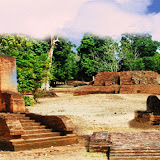
The Muarajambi Temple Compound Site is located in the Muarajambi Village, in the District of Maro Sebo, Muaro Jambi Regency, Jambi Province. From Jambi city, the site is less than 40 kilo-meters and can be reached by land transportation or through the river in one hour. The site is spread along 7.5 kilo-meters of the riverbanks of Batanghari River in which old canals or man-made rivers are positioned to connect the Batanghari River with the site. Through these ancient canals that circulate the site, people could reach the temple compounds. In the Muarajambi Temple Compound Site that covers an area of 2062 hectares, there were at least 82 ruins of ancient buildings made of brick construction. Seven of these ancient temples have been given intensive conservation treatment; meanwhile the remaining structures are covered with primary and secondary vegetation, and surrounded by the local community plantation of Sumatran endemic plants (planted by the local people known as Menapo). The seven temple compounds are the Gumpung, Tinggi I, Tinggi II, Kembar Batu, Astano, Gedong I and Gedong II, and the Kedaton Temple. In addition to that conservation treatment, several of the ancient canals and the old ponds that were previously covered with water vegetation have been cleared and are now restored to normal, such as the ancient canals in Jambi River and the Telago Rajo Pond.

Based on archaeology research and historical sources, the Muarajambi Temple Compound Site was once the centre for worship and education of the Buddhist religion in the period of the Ancient Malay Kingdom in the 7th - 14th century AD.

Source: http://whc.unesco.org/en/tentativelists/5465/

Friday, December 11, 2009

Muarajambi Archaeological Site

MUARAJAMBI is located on Batanghari riverside, around 22 kilometers eastern Jambi city, exactly in Muarajambi village, Marosebo sub-district, Muaro Jambi regency.

The name of Muarajambi first appeared in western literature on a report written by a navy officer from United Kingdom named S.C. Crooke in 1883. The officer was assigned by colonial governance center in Madras, India to do mapping (survey) on hydrology and to record regions along the Batanghari River for military concern.

In his record, Crooke mentioned that he saw ruins of brick construction in the Muarajambi forest. He also reported finding of a stone elephant sculpture. As an evidence of the visit, Crooke brought a sculpture head having curly hair like a wig belongs to judge in England to Penang Island, Malaysia.

Crooke’s description about the sculpture hair model may figure Buddha sculpture having its hair chiseled like that. He also wrote about the host villagers’ conviction saying that Muarajambi has ever been a capital of an ancient kingdom (Anderson, 1971: 396). Beside the relics in Muarajambi, Crooke also revealed his witness about Hindu sculptures – he means Buddhists – found in Jambi city.

The Crooke shallow information then enriched by T. Adam, a Dutchman visiting Jambi in 1921. He mentioned some sculptures that he recognized as elephant sculpture, standing Buddha, an object like a mortar and a stone throne or padmasana.

Adam also saw brick construction ruins in Muarajambi, though his attention was more on Candi Stano (Astano = grave) in the hind village which structure was partially seen. Similar to Crooke, Adam did not mention other archaeological heritage except construction and statue (1921:194 – 197). Since he only recorded findings within the village and was not going further into jungle.

Thirteen years later, F.M. Schnitger visited Muarajambi. He repeated what Adam did by collecting additional information about names of new temples, they are Gumpung, Tinggi, Gunung Perak, Gudang Garem, Gedong I and Gedong II (Schnitger, 1937:6; 1964:19).

During his stay in Muarajambi, Schnitger did excavation in the inner part of some temples. Though, the found artifacts have not been reported in his writing. It should be noted that Schnitger is the first scholar relating the Muarajambi Site to ancient Malay (Mo-lo-yeu) mentioned in Chinese manuscript XVII century. He went through a small river called Melayu in western part of Muarajambi village as basic argumentation.

In 1954, this site was researched by archaeologist of Indonesia. At that time, the research was conducted by Department of Education and Culture team lead by R. Soekmono. Crooke, Adam and Schnitger records are used as reference. The team took new photos to enrich the existing collection (Soekmono, 1984: 15-16). They assumed there is relation between this site and Sriwijaya kingdom, without leaving further explanation.

For about 20 years, the attention against the Muarajambi Site practically stopped. Then in 1975, restoration was started by Directorate of History and Archaeology, Department of Education and Culture. During forest sweeping mission, the workers in the field successfully showed large seven temples area: Kotomahligai, Kedaton, Gedong I and II, Gumpung, Tinggi, Kembarbatu, dan Astano.

A 10x120 meter pound was also found on the southern Candi Tinggi , which the host villager called Telagorajo. Surprisingly, the name of Gudang Garem and Gunung Perak as reported by Schnitger was not known by the villagers.

Archaeological information of Muarajambi Site is more complete after Bakosurtanal (National Survey and Mapping Coordination Board) did aerial photo on the temples area in 1985. This photograph has produced an accurate basic map consisting information about distribution of ancient building, canal system, and the site micro physic area data. It is visibly on the map that the Muarajambi Site has canal system which is made encircling natural levee.

Apparently there are more temples than initially seven temples known after the finding of about 40 more menapo. Menapo is a hill of bricks originally the ruins of building or narrow yard surrounded by trench made by ancient people.

Of the photograph, it is identified that the Batanghari River stream moved into southern part of the site which was previously nearby. The villagers’ houses in Muarajambi village are at present built on a new natural levee which is not as old as the Muarajambi Site.

Through the research since 1972 to 1995, National Archaeological Research Centre concluded Muarajambi has ever been multitude settlement. Thousands fragments of ceramic found during the research, excluding ceramics found together with other cultural articles after the restoration and paths making.

The Site occupant had admitted writing. This is shown on finding of some short inscriptions written on old Javanese which are revealed on the brick surface. Amongst are read as si, ma, ya, hra, hu, or ka. Some are not singular letter, but short word like nanaya (Suhadi, 1985: 259).

The effort to identify age of the temples applying paleography became more complete after finding of inscribed golden plaque from both temples areas. Boechari summarized relative age of both areas started from IX to XII century (Boechari, 1985:238).

The Boechari’s summary similar to Abu Ridho analysis applying Chinese ceramic as the research object. The observation against formal aspect of the ceramics (form, material, style and color) has lead to a summary that the majority is from China since XI to XIV century.

In less number, there were ceramics from Southeast Asia, namely Thailand, Khmer (Cambodia) and Myanmar (Burma) made of porcelain or stoneware. The ceramics from Southeast Asia are younger than the ceramics from China, as they are there since XIII century and after (Ridho, 1995).

Apparently, it is found that not all imported ceramics are made of porcelain or stone. There are many ceramic ruins made of shard. The material color is brown reddish or yellow reddish, thin, hard, and soft surface. The shard burning is done in high temperature over or almost 1.000 Celsius.

Abu Ridlo predicted the shards are from Thailand, particularly Satingpra in Southern part of the country which is known as one of the most important shard producer within Southeast Asia. The shapes are mostly in form of vessel or high-necked vase.

This characteristic differs to local shard ceramic which surface is rough, yellowish or yellow brownish, thick, fragile and often has decoration like ocher red lines. The local ceramics are also found in form of vessel, cooking pot, traditional oil lamp, pitcher or crock. In addition to those shapes, concave cap fragments and stove were also found.

Few white and broken white earthenware shards with turquoise glazing were also found in Muarajambi. This fragile and thick earthenware vessels are not local or China product, but are from West Asia, namely Persia or Iran.

In VIII – XII century, trading between China and Iran were through land and sea routes. Sumatera was one of port for ships from both countries during their journey. The trader from both Persia and China might stop by Muarajambi bringing the glazed shards to exchange with local commodity.

In addition to the ceramics, Muarajambi Site also brought to finding of some small beads made of stone and glass. The stone are chalcedony made of orange white cornelian, and agate stone with white and black lines forming lining. The shapes are miscellaneous, tetragonal double cone, spherical and oval.

Glass beads discovered during the surface excavation and survey are in various colors: light red, red brownish, yellow, green, green yellowish, and blue. Finding of glass fragments in the form of conglomeration of hundreds black beads nearby Candi Astano becoming indication that the Muarajambi community has ever produced beads.

This prediction is reasonable as the Puslitarkenas research in 1987 surrounding the temple found hundreds stone, glass and terracotta beads either broken or intact. In the same time, some glass trickle remains, combustion residue, curdled beads clod and crucible which indicate glass processing activities (Hardiati, 1988: 229).

Gold coin, gold ring and other gold jewelry scraps were also discovered, as well as artifacts found in Muarajambi Site in different occasion. Gold artifacts were mostly discovered in peripih of main building of Candi Gumpung and ancillary buildings in Candi Tinggi and Kembarbatu.

The gold metals are in form of thin plaques, some others are made like jewelry. In the same time, small red, purple and blue jewels were also found. Two purple stone have inscription written on siddham (prenagari).

Only few bronze articles were found in Muarajambi Site and were not intact. Among the found bronze statue remains are part of wrist with chakra motif chiseled on the foot. The wrist is confirmed coming from Buddhist statue (Utomo, 1984: 72-73)

Other bronze artifact finding was giant bronze vessel in 1994 in eastern Candi Kedaton. This vessel is the only big bronze artifact which is discovered fully. The height is 67 centimeters, diameter 78 centimeters, and weight 250 kilograms. The function has not yet identified. Considering that the discovery nearby temple, the bronze vessel is suspected having connection with religious ceremonies.

The nearby ancient buildings location in Muarajambi enabled the host community mobility. This is reflected from the distance between the temple buildings and menapo which is around 300 meter far. The finding of thousands ceramic artifacts surrounding the temple impressed the host community concentration living nearby the temple area (Rangkuti and Rosita, 1988).

Watching the concentrated finding of archaeological sites, many experts then connecting the Muarajambi Site to ancient Malay Kingdom as what Schnitger revealed. This prediction is reasonable after identifying no other sites in Jambi having such concentrated archaeological heritage except Muarajambi.

The length of sites which is more than seven kilometers and the width of 200 – 400 meter becoming adequate reason to predict the important role of the Site in the ancient time. More support either from individual or organization is required to discover the bunch of archaeological heritage in Muarajambi.

Yet, so far there has no expert surely identify the site as governance centre of the ancient Malay kingdom, unless connecting it to the kingdom based on its age.

The writing by Junus Satrio Atmodjo
Translated by : The blogger...