Pages

Wednesday, June 23, 2010

Kembarbatu Temple


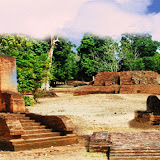
The Kembarbatu temple compound is located on 250 meter southeast Tinggi Temple, exactly on S 01° 28’ 39.7”, E 103°40’ 15.2”, while the dimension of land is about 59 m x 63 m. The temple which was reconstructed in 1994-1995, has discovered: 1 main temple, 5 reconstructed perwara, 2 other structures which function has not been identified, surrounded fence, gate and surrounded canal. The main temple facing to east, Perwara I facing to eastwest, perwara II and V facing to east and Perwara III and IV facing to North. Temples within the Kembarbatu temple compound are: main temple 11,39 m x 11,33 m x 2,82 m, Perwara I 11,60 m x 11 m x 1,86 m, Perwara II 3,75 m x 3,45 m x 1,30 m, Perwara III 8,09 m x 5,79 m x1,46 m, Perwara IV 12,32 m x 12,17 m x 0,65 m, Perwara V 5,10 m x 5,07 m x 0,92 m. Based on findings around, including bronze gong with Chinese letters on, golden plaque, gems, bricks with Old Java letters, and Chinese ceramic, it can be concluded that the structures had been constructed during 10 - 12 Century.

Tinggi Temple


Tinggi Temple is one of temples in the Muarajambi temple site compound, located on the northeast of Gumpung temple compound, exactly on S 01° 28’ 33.7”, E 103° 40’ 07.3”. The width of this temple is 2.92 Ha with one main temple, six perwara and enclosed fence. The temples had been reconstructed in 1980 – 1982 including the main temple with dimension of 16 x 16 m and 7.6 m height. Of archaeological research conducted during the resconstruction, initially, the temple was constructed in two phases; the inner part of the older construction was still in original shape in the time it was found. While, square perwara are located on the northeast, southwest, and south of the main temple. Currently, the remaining structures are the foundation and few footer parts. The main entrance is located on the east and west and a smaller gate on the west.

Gedong II Temple


Gedong II temple compound is located on S 01° 28’ 32.9’, E 103° 39’ 27.9’, in western part of Gedong I temple. The dimension of this temple compound is 75 m x 67,5 m surrounded by concrete fence and a main gate on the east. The compound consists of a main temple and 2 perwara. In the first perwara (in front of the main temple) is wooden pillar base, it shows us that in the past it was concrete structure in the base part and wooden structure on the upper part with tile roof. the yard is covered by pavement. Beside the temple structures, there found an arca called Arca Gadjahsingha. currently the arca is kept in collection hall of the Muarajambi temple compound site. During restoration of the temple in 2002, another arca as found called Dwarapala (keeper) on the left of entrance ladder, the arca is currently also kept in the collection hall.

GUMPUNG Temple


Gumpung Temple is located on S 01° 28’ 39.5”, E 103° 40’ 02.0”, and is one of large temple compound in the Muarajambi archaeological site. Gumpung temple is first called by F.M. Schnitger in his report in 1937. Boechari, an arcaeologist in reading old inscription, in his report wrote that based on result of his reading on the golden inscription found in the Gumpung temple, it is predicted that the Gumpung temple compound was constructed in the mid of 9 century to early 10 century. Of the golden inscription, it is found that Gumpung temple was prayer centre of Buddhist. This is supported with the finding of Pradjaparamita and other artifacts related to the Buddhist religious ceremony. Gumpung Temple surrounded by square fence in dimension of 150 m x 155 m. The land surface height is about 14,7 mdpl, directs to east, based on the main gate facing to east. While, the main temple is 17,9 m x x 17,3 m and the perwara 9,85 m x 9,75 m. the temple yard divided into some rooms, each surrounded by concrete fence and entrance gate. Currently, the remaining fences and entrance gates lost and result of restoration in 1982 had restored the remaining structure. While the original fence remains can be found under the protection building on the north of the temple.