
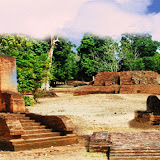
The name of Muarajambi first appeared on a report written by a navy officer from United Kingdom named S.C. Crooke in 1820. Crooke reported that he saw ruins of brick constructions and found a stone elephant sculpture. The Crooke’s description then enriched by T. Adam, a dutchman visiting Jambi in 1921. He also did not mention archaeological heritage except the constructions and arca. Thirteen years later, F.M. Schnitger visited Muarajambi. He added some information about names of new temples, they are Gumpung, Tinggi, Gunung Perak, Gudang Garem, Gedong I and Gedong II. Schnitger did excavation in the inner part of some temples. Schnitger is the first scholar relating the Muarajambi Site to ancient Malay (Mo-lo-yeu) mentioned in Chinese manuscript XVII century. He went through a small river called Melayu in western part of Muarajambi village as basic argumentation. In 1954, this site was researched by by Department of Education and Culture team lead by R. Soekmono. The team took new photos and assumed there is relation between this site and Sriwijaya kingdom. Then in 1975, restoration was started by Directorate of History and Archaeology, Department of Education and Culture. During forest sweeping mission, the workers in the field successfully showed large seven temples area: Kotomahligai, Kedaton, Gedong I and II, Gumpung, Tinggi, Kembarbatu, dan Astano. In 1985, Bakosurtanal (National Survey and Mapping Coordination Board) did aerial photo on the temples area. It is visibly on the map that the Muarajambi Site has canal system which is made encircling natural levee. Of the archaeological researches, shows that Muarajambi Site is an old malay kingdom heritage which has been developed since the 8th to 14th century by Mahayana Buddhist.



1 comments:
Crooke visited Muara Jambi in 1820, not 1883. Can you change it please?
Best wishes to all lovers of this temple site
Fiona
Post a Comment
leave your comment